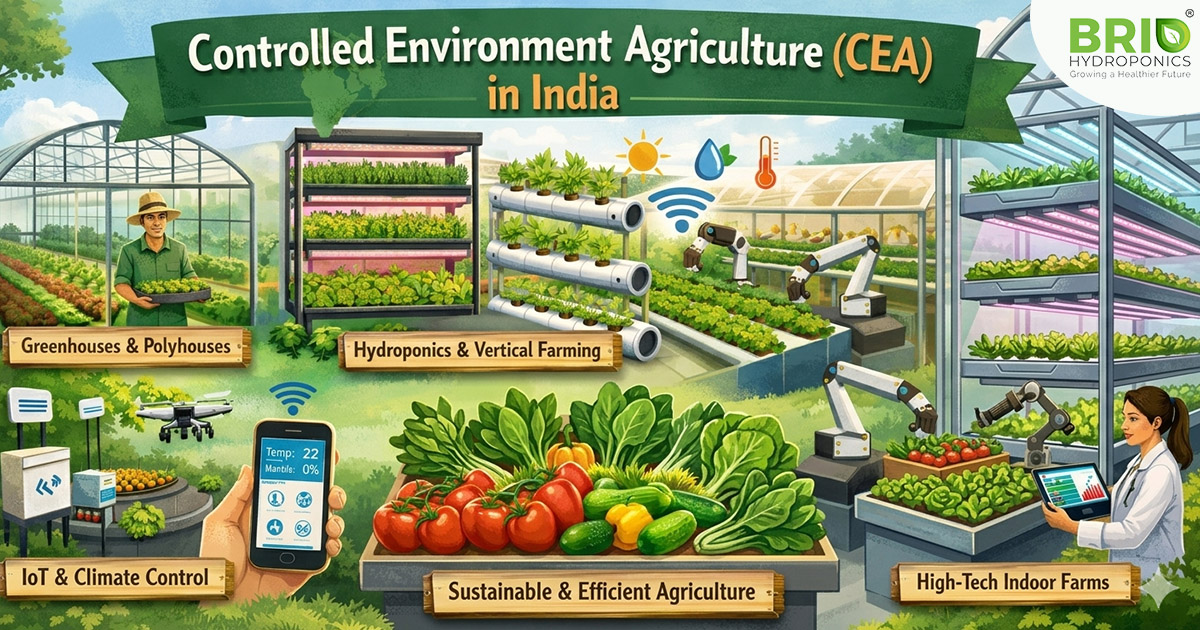
Controlled Environment Agriculture (CEA) is a method of growing crops in a fully managed environment where factors like temperature, humidity, light, water, and nutrients are carefully controlled. Instead of depending on natural weather conditions, CEA allows farmers to create ideal growing conditions for plants throughout the year.
In simple terms, what is CEA farming? It is a system where agriculture is done inside controlled spaces such as greenhouses, polyhouses, or indoor farms using modern technology.
This approach is gaining attention as one of the most reliable controlled farming techniques, especially where consistency, quality, and efficient resource use are important.
Understanding Controlled Environment Agriculture
Controlled environment agriculture in India focuses on reducing uncertainty in farming by managing all key growth factors. Traditional farming depends on rainfall, soil conditions, and seasonal changes, while CEA removes these variables.
In CEA systems:
- Temperature is regulated
- Humidity is controlled
- Light is managed using natural or artificial sources
- Nutrients are delivered precisely
- Water usage is optimised
This creates a stable environment where crops can grow efficiently without external disruptions.
What is CEA Farming?
To explain clearly, what is CEA farming:
It is a farming method where crops are grown inside enclosed or semi-enclosed structures with controlled environmental conditions using advanced technologies.
CEA includes multiple systems such as:
- Hydroponics
- Aeroponics
- Aquaponics
- Vertical farming
Among these, CEA hydroponics in India is one of the most widely used approaches because it combines soilless farming with environmental control.
Types of Controlled Environment Agriculture Systems
CEA is not limited to one setup. There are different types of systems used depending on scale, budget, and crop type.
1. Greenhouse Farming
Greenhouses use transparent materials to allow sunlight while controlling internal temperature and humidity.
Features:
- Protection from extreme weather
- Controlled irrigation
- Improved crop quality
2. Polyhouse Farming
Polyhouses are similar to greenhouses but use polyethylene covering.
Features:
- Cost-effective compared to glass greenhouses
- Suitable for various crops
- Widely used in commercial farming
3. Indoor Farming
Indoor farming in India involves growing crops inside buildings using artificial lighting and climate control systems.
Features:
- No dependency on sunlight
- Full environmental control
- Suitable for urban areas
4. Vertical Farming
Plants are grown in stacked layers to maximise space utilisation.
Features:
- High production in limited space
- Ideal for cities
- Works well with hydroponics
CEA Hydroponics
CEA hydroponics in India combines hydroponic systems with environmental control. This means plants grow without soil while temperature, humidity, and nutrients are precisely managed.
Benefits:
- Faster growth
- Higher yield
- Consistent quality
Hydroponics is one of the most efficient methods within CEA because it reduces water usage and improves nutrient delivery.
Controlled Farming Techniques Used in CEA
Several controlled farming techniques are used in CEA systems to ensure optimal crop growth:
Climate Control
- Temperature is maintained using cooling or heating systems
- Humidity is regulated to prevent diseases
Light Management
- Natural sunlight is optimised
- LED grow lights are used in indoor setups
Nutrient Management
- Nutrients are delivered in precise quantities
- pH and EC levels are monitored
Irrigation Control
- Automated irrigation systems reduce water wastage
- Water is recirculated in hydroponic systems
Pest and Disease Control
- Controlled environment reduces pest exposure
- Minimal pesticide use
Role of Technology in Agriculture
CEA relies heavily on technology in agriculture in India. Modern tools and systems make it possible to monitor and control farming conditions accurately.
Key technologies used:
Sensors
Sensors track:
- Temperature
- Humidity
- Soil or water conditions
- Nutrient levels
Automation Systems
Automation controls:
- Irrigation
- Nutrient dosing
- Lighting
Data Monitoring
Farmers can monitor data in real-time using software or mobile applications.
Artificial Intelligence and IoT
Advanced systems use AI and IoT to:
- Predict plant growth
- Optimise resource usage
- Reduce human error
Precision Agriculture
Precision agriculture in India is closely linked to CEA. It focuses on using data and technology to make accurate farming decisions.
In CEA:
- Nutrients are given in exact quantities
- Water is used efficiently
- Growth conditions are optimised
This improves productivity and reduces waste.
Indoor Farming in India
Indoor farming in India is an important part of CEA, especially in urban areas where land is limited.
Benefits:
- Can be set up in warehouses or buildings
- Allows year-round farming
- Reduces transportation time for fresh produce
Indoor farming is commonly used for:
- Leafy greens
- Herbs
- Microgreens
Advantages of Controlled Environment Agriculture
CEA offers several benefits compared to traditional farming:
Year-Round Production
Crops can be grown throughout the year without seasonal limitations.
Higher Yield
Controlled conditions result in better productivity.
Water Efficiency
CEA systems use less water compared to traditional farming.
Better Quality Produce
Uniform growth conditions ensure consistent quality.
Reduced Risk
Protection from weather and pests reduces crop loss.
Efficient Land Use
Suitable for areas with limited land availability.
Challenges of CEA Farming
Despite its advantages, CEA also has some challenges:
High Initial Investment
Setting up infrastructure and technology requires capital.
Technical Knowledge
Farmers need to understand system management and monitoring.
Power Requirement
Electricity is needed for lighting, cooling, and automation.
Maintenance
Regular monitoring and maintenance are essential.
Applications of CEA Farming
CEA is used in various agricultural applications:
- Commercial vegetable production
- Urban farming projects
- Research and development
- High-value crop cultivation
It supports both small-scale and large-scale operations.
Future of Farming
The future of farming in India is moving towards technology-driven solutions like CEA.
Reasons include:
- Increasing population
- Limited agricultural land
- Water scarcity
- Demand for high-quality food
CEA provides a solution by improving efficiency and productivity.
Why CEA is Gaining Importance
Controlled environment agriculture in India is growing because it addresses many challenges faced by traditional farming:
- Reduces dependency on climate
- Improves yield consistency
- Supports sustainable practices
- Enables farming in non-traditional spaces
Comparison: Traditional Farming vs CEA
|
Factor |
Traditional Farming |
CEA Farming |
|
Environment |
Natural |
Controlled |
|
Yield |
Variable |
Consistent |
|
Water Usage |
High |
Low |
|
Crop Cycles |
Seasonal |
Year-round |
|
Pest Issues |
High |
Low |
|
Technology Use |
Limited |
High |
Business Opportunities in CEA
CEA offers multiple business opportunities:
- Commercial farming
- Supply to supermarkets and restaurants
- Export-quality produce
- Setup consultancy
- Technology solutions
It is suitable for entrepreneurs looking to enter modern agriculture.
Practical Approach to Start CEA Farming
To begin with CEA farming:
- Select the right crop
- Choose the appropriate system (greenhouse, indoor, hydroponics)
- Plan investment and infrastructure
- Install automation and monitoring systems
- Start with a small setup
- Scale gradually
Conclusion
Controlled Environment Agriculture is a modern farming approach that focuses on precision, efficiency, and consistency. By managing all key growth factors, CEA ensures better crop quality, higher yield, and reduced dependency on natural conditions.
Understanding what is CEA farming, along with its techniques and technologies, helps in recognising its importance in modern agriculture. With the growing demand for sustainable and efficient farming solutions, CEA is becoming a strong part of the future of farming in India.
As technology in agriculture in India continues to improve, controlled environment farming will play a key role in meeting food demand while using resources efficiently.