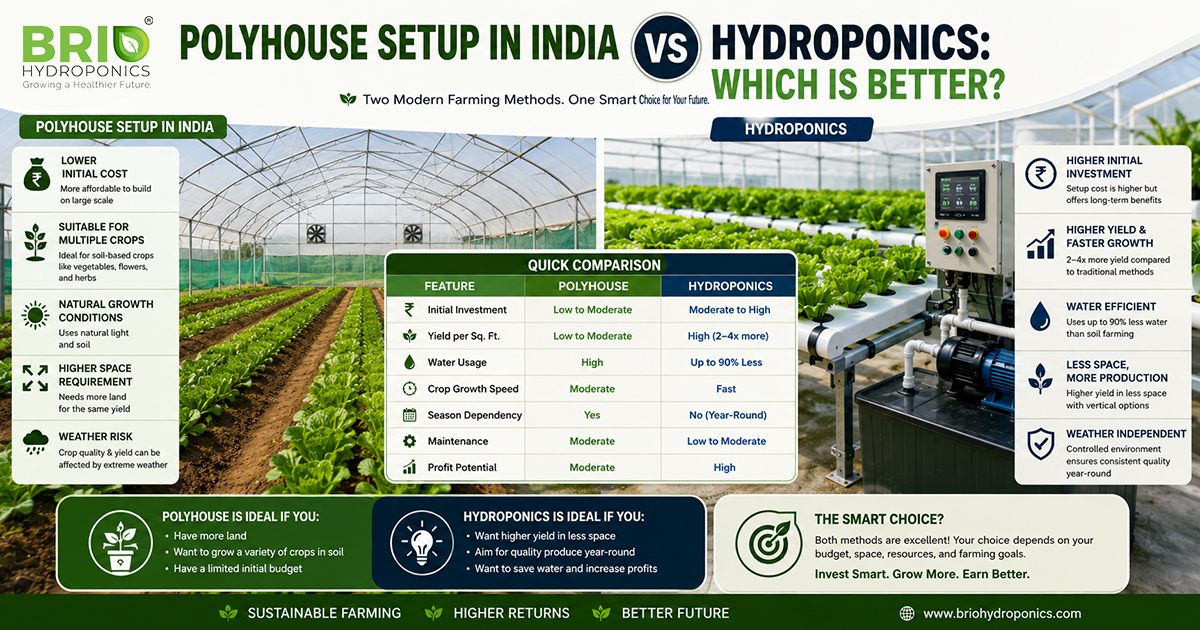
The question farmers and agri-entrepreneurs across India are asking today is: which is better, a polyhouse setup or a hydroponic farm? Both fall under protected cultivation in India, but they are quite different in how they work, what they cost, and what kind of returns they deliver. This article gives you an honest, practical comparison so you can make the right call for your land, budget, and market.
Walk into any agricultural exhibition in India today, from Pune to Patiala, and you will find two technologies dominating the conversation: polyhouse farming and hydroponics. Both are forms of protected cultivation in India, meaning they shield crops from the open environment. But that is roughly where the similarity ends.
One is rooted in traditional soil-based growing, just moved indoors. The other does away with soil entirely. One is more accessible to traditional farmers. The other requires a higher level of technical knowledge and investment. And the profitability picture is different for each, depending on what you grow and where you sell it.
First, Let Us Understand Both Systems Clearly
Polyhouse Farming
-
Crops are grown in soil inside a covered structure
- UV-stabilised plastic film over GI frame is the standard setup
- Temperature, humidity and wind are controlled naturally
- Works for vegetables, flowers, and fruits
- Lower technical skill requirement to begin
- Widely subsidised under government schemes across India
- Familiar to most farmers transitioning from open-field farming
Hydroponic Farming
- Crops are grown without soil in a nutrient-water solution
- Usually set up inside a polyhouse or climate-controlled structure
- NFT, DWC, Dutch bucket, or vertical systems are used
- Higher yields per square foot than soil-based farming
- Requires more technical knowledge and precision
- Higher setup cost but better returns per crop cycle
- Targets premium buyers: hotels, modern retail, direct consumers
An important point that many people miss: hydroponics is not a replacement for a polyhouse. It is often set up inside one. A hydroponic greenhouse farming setup typically uses a polyhouse as the outer protective structure. So the two technologies can and often do coexist. The real question is whether you add a hydroponic growing system inside your structure or simply use soil.
Difference Between Polyhouse and Hydroponics: A Full Comparison
Here is a detailed difference between polyhouse and hydroponics across the factors that matter most to a farmer or investor in India:
|
Parameter |
Polyhouse (Soil-Based) |
Hydroponics |
|
Growing Medium |
Soil with organic/chemical fertilisers |
Water-based nutrient solution, no soil Unique Advantage |
|
Water Usage |
Moderate savings vs open field; drip irrigation helps |
Up to 90% less water than soil farming Major Edge |
|
Yield Per Sq. Ft. |
Better than open field; same plant spacing |
Significantly higher yields per sq. ft. Wins Here |
|
Crop Suitability |
Vegetables, flowers, fruits, capsicum, tomatoes, gerbera |
Leafy greens, herbs, cherry tomatoes, capsicum, strawberries |
|
Setup Cost |
Lower overall investment More Accessible |
Higher upfront cost due to growing system, nutrient setup |
|
Technical Skill |
Moderate; familiar to experienced farmers Easier Start |
Higher; requires understanding of pH, EC, nutrient management |
|
Government Subsidy |
Well covered under MIDH and state schemes Strong Support |
Partial support; infrastructure subsidy available in some states |
|
Produce Quality |
Good quality; depends on soil health management |
Very consistent quality; cleaner, pesticide-reduced produce Premium Grade |
|
Market Positioning |
Regular retail, mandis, local markets, wholesale |
Premium retail, hotels, restaurants, direct consumers Better Margins |
|
Payback Period |
Typically shorter at smaller scale Faster ROI |
Longer but higher profitability once established |
|
Crop Cycles/Year |
2 to 3 cycles depending on crop |
4 to 6 cycles for fast-growing crops like lettuce More Cycles |
|
Scalability |
Easy to scale with familiar methods |
Scales well; automation makes large operations efficient |
Polyhouse Setup in India: What You Need to Know
A polyhouse setup in India is one of the most established forms of protected cultivation. The concept is straightforward: you build a structure using GI pipes and cover it with a UV-stabilised polyethylene film. This creates a controlled environment where temperature, humidity, wind, and pests are partially managed, giving crops a better growing environment than open fields.
What Does a Polyhouse Cost in India?
The polyhouse farming cost in India varies based on the type of structure, automation level, and state. A basic naturally ventilated polyhouse is the most affordable option and is what most small and mid-scale farmers begin with. A hi-tech polyhouse with fan-and-pad cooling, automated irrigation, and climate sensors costs significantly more but allows for tighter control over crop conditions year-round.
Typical Components of a Polyhouse Setup Cost in India
- 1GI tubular frame and UV polyethylene film cover (main structure cost)
- 2Drip irrigation or micro-sprinkler system for water management
- 3Fan-and-pad evaporative cooling system for temperature control (hi-tech)
- 4Shade net installation for light diffusion in summer
- 5Insect-proof net for pest exclusion at entry points
- 6Civil work including site preparation, pathways, drainage
- 7Water source setup including bore well or tank connection
- 8Growing media, fertilisers, and initial seed or seedling cost
Best Crops for Polyhouse Farming in India
The crops that work best in a polyhouse farming setup are those that benefit from a controlled temperature and reduced pest pressure but grow well in soil. Some of the most popular and profitable polyhouse crops in India include:
Coloured capsicum (yellow, red, orange) remains one of the highest-value polyhouse crops in India. Gerbera flowers are extremely popular for floriculture under polyhouse. Tomatoes, cucumbers, and brinjal also do very well. Roses and other cut flowers for the urban and export market are another strong choice, particularly in states like Karnataka, Maharashtra, and Himachal Pradesh.
Hydroponic Greenhouse Farming in India: The Next Level
Hydroponic greenhouse farming takes protected cultivation a step further. Instead of growing in soil, crops receive all their nutrients through a precisely managed water solution. The result is faster growth, higher yields, more crop cycles per year, and produce that consistently meets premium quality standards.
The hydroponics vs polyhouse farming debate really comes down to this: hydroponics produces more from the same space, but it requires more investment and more careful management. If you are willing to learn and invest, the returns are significantly better. If you are a first-time grower or working with a tight budget, starting with a polyhouse soil setup may make more sense before adding a hydroponic layer.
A very common and smart approach adopted by successful farmers in India is to start with a polyhouse structure and transition to hydroponics inside it over one to two years. This allows you to recover part of your polyhouse investment while learning the market, then upgrade to hydroponics when you are ready for the next level.
Polyhouse vs Hydroponics Profit Comparison
The polyhouse vs hydroponics profit comparison is one of the most critical factors for any investor. Here is an honest picture of how revenue and profitability differ between the two approaches.
Polyhouse Farming Profit Drivers
In a polyhouse, profitability depends heavily on crop selection and market linkages. High-value crops like coloured capsicum, exotic vegetables, and cut flowers command strong prices. The advantage is that the operational knowledge required is closer to conventional farming, so the learning curve is shorter. However, the per-square-foot revenue potential is lower than hydroponics for most crops.
Hydroponic Farming Profit Drivers
Hydroponic farms targeting premium buyers consistently achieve better margins on a per-kilogram basis. Lettuce, basil, microgreens, and cherry tomatoes grown hydroponically and sold directly to hotels, cloud kitchens, or modern retail chains can generate revenue that is considerably higher than the same crops sold through a wholesale mandi. The more crop cycles per year also compound the annual earnings significantly.
|
Profit Factor |
Polyhouse |
Hydroponics |
|
Revenue per Sq. Ft. |
Moderate; depends on crop and market |
Higher; premium crops command better prices |
|
Annual Crop Cycles |
2 to 3 cycles per year |
4 to 6 cycles for fast-growing crops |
|
Market Channel |
Mandi, wholesale, local retail |
Hotels, supermarkets, direct consumers |
|
Price Realisation |
Market rate; competition from open-field produce |
Premium pricing; less competition from traditional farms |
|
Operating Cost |
Lower; fewer inputs per cycle |
Higher nutrient and electricity costs; offset by premium revenue |
|
Overall ROI Potential |
Steady and reliable; moderate growth |
Higher ceiling; requires investment in buyers and quality |
Polyhouse Farming Subsidy India: What You Can Claim
One area where polyhouse farming has a clear and well-established advantage over pure hydroponics is government subsidy support. The polyhouse farming subsidy India framework is more developed, with national and state-level schemes directly covering polyhouse construction costs.
|
Scheme / Programme |
What It Covers |
Who Can Apply |
|
MIDH (Mission for Integrated Development of Horticulture) |
Subsidy on polyhouse/greenhouse construction, drip irrigation, horticulture infrastructure |
Individual farmers, FPOs, SHGs |
|
National Horticulture Mission (NHM) |
Protected cultivation infrastructure including polyhouse and shade net house |
Farmers registered with state horticulture dept. |
|
State Horticulture Schemes |
Varies by state; Maharashtra, Karnataka, Gujarat, Telangana have active schemes |
State-registered farmers and agri-entrepreneurs |
|
NABARD Agricultural Loans |
Low-interest loans for hi-tech and protected farming projects |
Farmers, agri-entrepreneurs, FPOs |
|
PM Kisan Sampada Yojana |
Post-harvest infrastructure, cold storage, processing units linked to farm |
Food processing and agri-business enterprises |
For hydroponic farming setups, subsidies are available primarily on the polyhouse structure component. The hydroponic growing system itself (NFT channels, nutrient tanks, grow media) is generally not directly subsidised under national schemes at this time, though some state governments are beginning to introduce support for hi-tech farming systems. Always verify the latest scheme guidelines with your state horticulture department before planning your investment.
Which is Better: Hydroponics or Polyhouse Farming?
The honest answer to the question which is better hydroponics or polyhouse farming is: it depends on your specific situation. Here is a practical guide to help you decide:
Choose Polyhouse If...
- You are transitioning from traditional open-field farming
- Your budget is limited and you want lower upfront risk
- You want to grow flowers, fruiting vegetables, or bulk crops
- You plan to access government subsidies which are easier for polyhouse
- Your market is local wholesale, mandi, or regional retail
- You want a shorter learning curve to start earning sooner
- Your land area is large and per-square-foot yield is less critical
Choose Hydroponics If...
- You have limited land and need maximum yield per sq. ft.
- You are targeting hotels, premium retail, or direct-to-consumer sales
- You want to grow high-value crops like lettuce, herbs, or microgreens
- You are open to investing in training and technical management
- Water availability is limited in your region
- You want multiple crop cycles per year to maximise annual revenue
- You are building an agri-business brand, not just commodity supply
Many experienced farmers and agri-investors in India are now combining both: they build a polyhouse structure for the outer shell, use soil for some sections with high-volume bulk crops, and dedicate other sections to a hydroponic NFT system for premium crops. This hybrid model spreads risk and allows you to serve multiple market segments simultaneously.
Common Mistakes to Avoid in Both Systems
Mistakes Farmers Make When Choosing Between Polyhouse and Hydroponics
-
Starting with a large commercial scale without testing operations at a small pilot level first
- Choosing crops based on what you know from open-field farming rather than what sells best from protected cultivation
- Not securing buyers before the first harvest, leading to distress selling at mandi prices
- Applying for subsidies after construction starts, which disqualifies you from most schemes
- Underestimating electricity and operational costs, especially for climate-controlled setups
- Skipping proper training on nutrient management (for hydroponics) or integrated pest management (for polyhouse)
- Not accounting for the cost of packaging, transport, and market development in the financial plan
Not Sure Which System is Right for You?
Talk to our protected cultivation experts. We help farmers and investors across India design the right setup based on their land, budget, and target market.
Frequently Asked Questions
Quick answers to the most common questions about polyhouse vs hydroponics farming in India.
What is the difference between polyhouse and hydroponics?
A polyhouse is a covered structure made of UV polyethylene film over a GI frame where crops can be grown in soil or through other methods. Hydroponics is a soil-free growing method where plants receive nutrients through water. Hydroponics can be set up inside a polyhouse. The key difference between polyhouse and hydroponics is the growing medium and the level of investment and technical knowledge required.
Which is more profitable: polyhouse farming or hydroponics?
Hydroponics generally offers higher profitability per square foot, especially when targeting premium buyers like hotels, modern retail, and direct consumers. Polyhouse farming with high-value crops like coloured capsicum or gerbera flowers can also be very profitable. The polyhouse vs hydroponics profit comparison ultimately depends on your crop selection, market linkages, and operational efficiency. Hydroponics has a higher ceiling but also a higher floor investment.
Is there a government subsidy for polyhouse farming in India?
Yes, the polyhouse farming subsidy India framework is well established. The Mission for Integrated Development of Horticulture (MIDH), the National Horticulture Mission, and various state horticulture departments provide subsidies on polyhouse construction. Subsidies typically cover a percentage of the structure cost and sometimes include drip irrigation. It is important to apply before starting construction, as most schemes require prior approval.
Can I set up a hydroponic system inside a polyhouse?
Yes, and this is actually the most common setup for hydroponic greenhouse farming in India. The polyhouse provides the protected environment (temperature control, pest exclusion, wind protection), and the hydroponic growing system sits inside it. Many farmers start with a basic polyhouse structure and add a hydroponic NFT or Dutch bucket system inside it over time.
What crops are best for polyhouse setup in India?
The best crops for a polyhouse setup in India include coloured capsicum, tomatoes, cucumbers, gerbera, roses, carnations, and exotic vegetables like zucchini and broccoli. These crops benefit from the controlled environment a polyhouse provides and command better prices than the same crops grown in open fields.
How much does a polyhouse setup cost in India?
The polyhouse farming cost in India varies based on the type of structure, level of automation, and state-specific factors like labour and material costs. A basic naturally ventilated polyhouse is the most affordable starting point, while a hi-tech fan-and-pad cooled polyhouse with automation costs significantly more. Getting a site-specific quote from a certified polyhouse manufacturer or horticulture consultant will give you the most accurate estimate for your location.
Is polyhouse farming better than open-field farming?
Yes, protected cultivation in India through a polyhouse delivers clear advantages over open-field farming: reduced pest and disease pressure, protection from harsh weather, better crop quality, year-round growing capability, and access to premium markets. While the initial setup cost is higher, the long-term advantages in terms of yield, quality, and market pricing make it a sound investment for serious farmers.
Which states in India are best for polyhouse or hydroponic farming?
Maharashtra (Pune, Nashik), Karnataka (Bangalore, Belgaum), Telangana (Hyderabad), Gujarat, Rajasthan, Himachal Pradesh, and Punjab are among the most active states for protected cultivation in India. States with large urban populations and strong demand for premium produce tend to offer the best market opportunities. Many of these states also have active horticulture subsidy schemes that reduce the polyhouse farming cost in India.