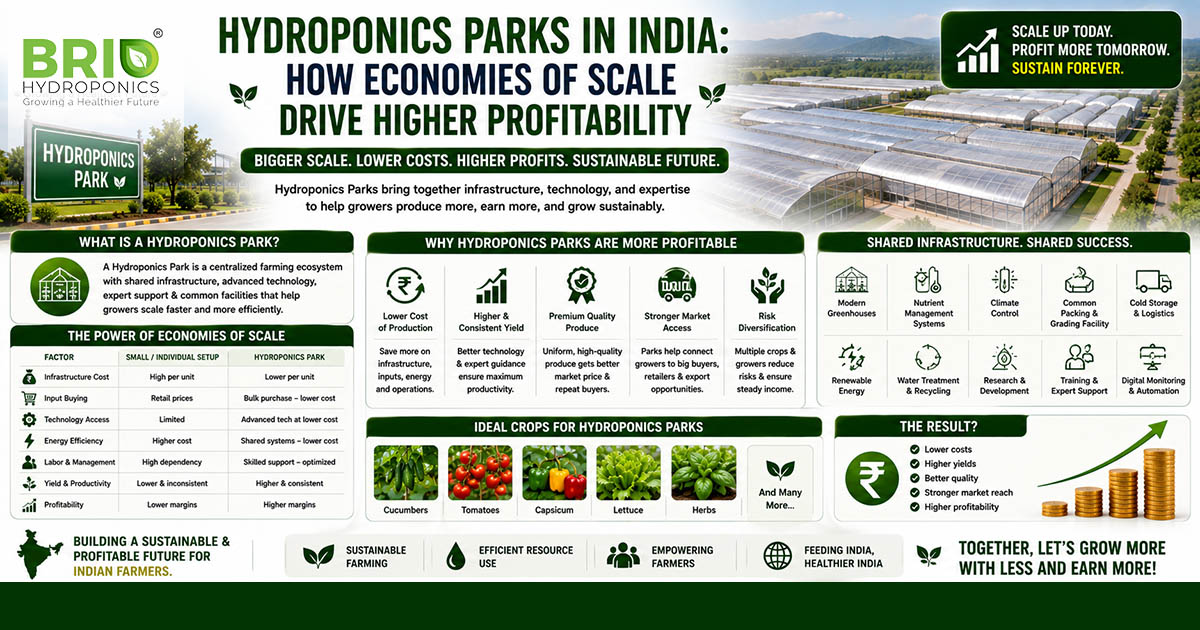
If you have been researching hydroponic farming in India, you have probably come across two very different pictures of the same business. One is a lone one acre polyhouse struggling with high per unit costs. The other is a large, professionally managed hydroponics park where dozens of growers share infrastructure, technology and market access. The gap in profitability between the two is not luck. It comes down to one simple economic principle: scale.
In this article, we break down what a hydroponics park in India actually is, why economies of scale change the profitability math so drastically, and what this means if you are evaluating hydroponic farming as an investment or a business.
What Is a Hydroponics Park?
A hydroponics park is a large, centrally developed campus, usually spread across 50 to 100 acres or more, where multiple hydroponic and greenhouse units operate under one roof of shared infrastructure. Instead of each grower building their own power backup, water treatment plant, cold storage, pack house and technical team, a hydroponics park provides all of this centrally, and individual investors or farm operators lease or own a plot within the park and run their crop cycles on top of that shared base.
This model is fairly common in industrial parks and SEZs, and it is now being applied to commercial hydroponic farming in India. The largest hydroponics park in Gujarat, Unnati, developed by Brio Hydroponics at Talod in Sabarkantha district, is a good example of how this works at scale, spread across 100 acres with fully automated, climate controlled greenhouses.
Why Economies of Scale Matter in Commercial Hydroponic Farming
Economies of scale simply means that the cost per unit of production falls as the size of the operation grows. In hydroponic farming, this plays out across almost every line item of the business. Here is where the savings actually come from.
1. Shared Infrastructure Cost
A standalone hydroponic farm has to absorb the full cost of borewells, water treatment, power backup, internal roads, security and administrative staff on its own small acreage. In a hydroponics park, this infrastructure is built once for the entire campus and its cost gets spread across every acre and every grower using it. This alone can bring down the hydroponic farming setup cost per acre quite significantly compared to building the same setup in isolation.
2. Bulk Procurement of Equipment and Inputs
Poly film, nutrient dosing systems, sensors, climate control equipment and growing media are all imported or sourced in bulk when a park is being developed for hundreds of acres at once. Bulk orders bring better pricing from suppliers than a single farmer buying a small quantity for a one or two acre unit, which directly lowers the capital cost of setting up each new block.
3. Access to Technical Expertise
Hydroponics is not a set it and forget it business. Crop management, nutrient science, pest control and system automation all need trained hands. A single small farmer usually cannot afford a full time agronomist or automation engineer. Inside a hydroponics park, this expertise is shared across all the units, so every grower gets access to the same quality of technical support that would otherwise be out of reach for an individual investor.
4. Stronger Market Linkages
Buyers such as hotels, retail chains, exporters and modern trade outlets prefer working with suppliers who can guarantee consistent volume and quality throughout the year. A hydroponics park, by pooling produce from many growers under one quality and branding umbrella, can negotiate better offtake agreements and prices than any single small farm could manage on its own.
5. Lower Risk Through Diversification
When many growers and crop varieties operate within the same park, the overall business is less exposed to the failure of a single crop cycle or a single grower's mistakes. This diversification effect is one of the underrated reasons large scale farming in India is increasingly seen as a more bankable investment than a scattered, individual farm model.
Case in Point: Unnati, the Largest Hydroponics Park in Gujarat
Brio Hydroponics developed Unnati Hi-Tech Hydroponics Park across 100 acres at Talod in Sabarkantha district, built using controlled environment agriculture technology with inputs from France, Israel and New Zealand. The park is designed to give investors, agripreneurs and land developers a ready to operate platform instead of asking them to build a hydroponics business from the ground up.
Within Unnati, investors can enter through block deals, equity investments or fixed return debt investments, while Brio Hydroponics handles the technical operations, crop management and market linkages end to end. This is the essence of the park model: the heavy lifting of infrastructure and expertise is done once, centrally, and every investor benefits from it without repeating that cost on their own small parcel of land.
- Fully automated, climate controlled greenhouses across the park
- High yield, residue free crop production through the year
- End to end management by Brio Hydroponics, from crop selection to sales
- Around 90 percent less water usage compared to conventional open field farming
Hydroponics Park vs a Standalone Hydroponic Farm
If you compare the two models side by side, the difference in cost structure and risk becomes clear.
|
Parameter |
Standalone Hydroponic Farm |
Hydroponics Park Model |
|
Infrastructure cost per acre |
Borne fully by one grower |
Shared across the entire park |
|
Access to agronomists and automation experts |
Often limited or unavailable |
Centrally provided to all growers |
|
Bulk purchase pricing on equipment and inputs |
Not available at small scale |
Available due to large volume orders |
|
Market and buyer access |
Depends on individual effort |
Backed by park level offtake agreements |
|
Risk exposure |
Concentrated in a single crop or unit |
Spread across many growers and crops |
|
Typical entry route |
Full ownership and full operational load |
Block deal, equity, or fixed return debt |
For most first time investors, a standalone one or two acre hydroponic setup ends up carrying a disproportionately high fixed cost burden relative to its output. A hydroponics park spreads that same fixed cost across a much larger, professionally run base, which is exactly why high ROI farming methods in India are increasingly being built around the park model rather than isolated units.
Why the Timing Favours Large Scale Hydroponic Investment
The numbers around India's controlled environment agriculture sector make a strong case for scale right now. Multiple industry estimates place the India hydroponics market on a growth path with a compound annual growth rate ranging from roughly 15 percent to over 20 percent through the early 2030s, driven by rising demand for pesticide free produce, shrinking arable land near cities, and growing urban demand for consistent, high quality fresh produce.
On the policy side, the government has been actively backing this shift. Hydroponics and other soilless cultivation methods have been folded into the Mission for Integrated Development of Horticulture, and structured credit routes such as the Agriculture Infrastructure Fund offer project loans at concessional interest rates for setting up this kind of infrastructure. Programs like these make it considerably easier for a large, well structured hydroponics park to raise capital than it is for a lone small farm to secure a similar loan on its own.
South India has seen strong early adoption around Bangalore, Hyderabad and Chennai, while Gujarat has emerged as a hub on the back of parks like Unnati. As more institutional and corporate money enters the sector, parks that already have the land, infrastructure and operating track record in place stand to capture a disproportionate share of this growth.
Who Should Consider Investing in a Hydroponics Park in India
The park model tends to suit a fairly specific set of investors and businesses.
-
Businessmen from manufacturing or construction who want to diversify into agriculture without running day to day farm operations themselves
- Land developers looking for a structured, income generating use for large parcels of land
- Agripreneurs who want to start a hydroponics business without bearing the full setup cost of infrastructure on their own
- Family offices and HNIs seeking fixed return or equity exposure to India's growing agri-tech and controlled environment agriculture sector
- Corporates and institutions wanting a sustainable, low water footprint agriculture investment that also supports food security goals
How Brio Hydroponics Structures Park Based Investment
Brio Hydroponics offers more than one way to participate in the Unnati hydroponics park, depending on how hands on or hands off an investor wants to be.
- Block Deals: purchase or lease a defined block within the park with Brio managing operations
- Equity Investments: take a direct stake in the business and its returns
- Debt Investments: fixed annual returns of up to 18 percent through a structured investment plan
- Debt (Horti) Investments: a horticulture focused fixed return route within the same park infrastructure
Across every route, the underlying advantage stays the same. The investor is buying into infrastructure, technology and market access that has already been built and proven at scale, rather than starting from zero on an isolated plot of land.
FAQs on Hydroponics Parks in India
What is a hydroponics park in India?
A hydroponics park is a large, centrally developed campus where multiple hydroponic and greenhouse units share common infrastructure such as power backup, water treatment, technical staff and market linkages. Unnati in Gujarat, developed by Brio Hydroponics across 100 acres, is one of the largest examples of this model in the country.
How does a hydroponics park lower the hydroponic farming setup cost?
It spreads the cost of infrastructure, bulk procurement and technical expertise across a much larger area and many growers, instead of one small farm bearing the full cost of building everything on its own. This is what brings down the setup cost per acre compared to a standalone unit.
Is commercial hydroponic farming profitable in India?
Yes, when it is set up and managed correctly. Hydroponic systems typically deliver higher yield per acre, faster crop cycles and premium pricing for residue free produce compared to conventional farming. Profitability improves further when the farm operates within a large scale, professionally managed setup such as a hydroponics park, where fixed costs are shared.
What makes Unnati the largest hydroponics park in Gujarat?
Unnati spans 100 acres at Talod in Sabarkantha district and uses controlled environment agriculture technology sourced from France, Israel and New Zealand. It is developed and managed by Brio Hydroponics, offering investors block deals, equity and fixed return debt investment routes into one centrally operated park.
How much water does hydroponic farming save compared to traditional farming?
Hydroponic systems typically use around 90 percent less water than conventional open field farming, since water is recirculated through the system rather than lost to soil absorption and evaporation.
Who can invest in a hydroponics park in India?
Businessmen looking to diversify, land developers, agripreneurs, HNIs and corporates seeking sustainable agri investments can all consider a hydroponics park. Entry routes vary from direct block ownership to equity participation and fixed return debt instruments, so the right fit depends on how involved an investor wants to be in daily operations.
Ready to Explore Large Scale Hydroponic Farming in India?
Whether you want to invest in a ready built hydroponics park like Unnati or set up a turnkey hydroponic project on your own land, Brio Hydroponics can walk you through the numbers, the technology and the returns. Book a free consultation with our team to understand which model fits your goals, your land and your budget.