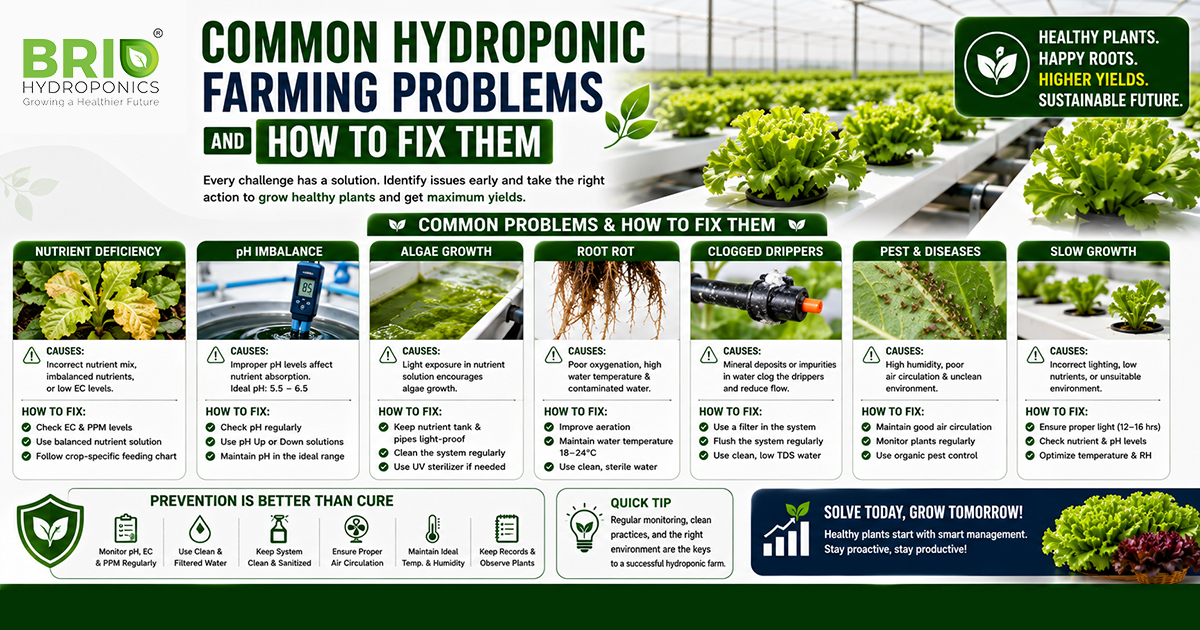
Every hydroponic grower, whether running a single grow tent or a multi acre commercial hydroponic farming setup, hits the same wall at some point. The leaves start looking off, growth slows down for no obvious reason, or the roots that used to be clean and white turn brown and slimy overnight. The good news is that almost every hydroponic problem traces back to a small handful of root causes, and once you know what to look for, most of these issues are quick to fix.
This guide walks through the most common problems growers run into with a hydroponic system, what actually causes them, and the practical steps to fix and prevent each one.
1. Root Rot in Hydroponics
Root rot is probably the single most feared problem in hydroponics, and for good reason. It can take a healthy looking crop down within days if it goes unnoticed. Roots that were once white and firm turn brown, slimy and start giving off a bad smell. Above the surface, you will usually notice wilting, curling leaves, yellowing and a general slowdown in growth, even though everything else in the system looks normal.
What Causes Root Rot
- Low dissolved oxygen around the root zone, which weakens roots and lets pathogens take hold
- Warm nutrient solution, generally above 24 to 25 degrees Celsius, which both lowers oxygen levels and creates ideal conditions for fungi like Pythium to spread
- Dirty reservoirs, pipes and grow trays where old slime and residue build up and shelter pathogens
- Unstable pH and EC, which stresses the roots and makes them easier to infect
- Poorly mixed or imbalanced hydroponic nutrient solutions that leave roots undernourished and less able to resist disease
How to Fix and Prevent Root Rot
- Keep the nutrient solution cool, ideally below 24 degrees Celsius, using shaded reservoirs, insulated tanks or a chiller in warmer months
- Increase oxygenation with air stones, air pumps or a higher flow rate in NFT and film based systems
- Clean reservoirs, pipes and channels on a fixed schedule rather than waiting for visible buildup
- Remove and discard any visibly rotted roots immediately so the infection does not spread to healthy plants nearby
- Check and correct pH and EC daily during the early stages of a crop cycle, since young roots are most vulnerable
- Sanitize tools such as scissors and gloves with isopropyl alcohol or a dilute bleach solution between uses to avoid spreading pathogens
2. Nutrient Deficiency Symptoms in Hydroponic Crops
In soil, plants can often scavenge trace nutrients even from a poor bed. In hydroponics, the nutrient solution is the only source of food for the plant, so any gap or imbalance shows up on the leaves fast, usually within a few days. Learning to read these nutrient deficiency symptoms early can save an entire crop cycle.
|
Nutrient |
What You See On the Plant |
Likely Cause |
|
Nitrogen (N) |
Older, lower leaves turn pale yellow first, growth slows down |
Weak nutrient dosing or too much water dilution |
|
Phosphorus (P) |
Leaves turn dark green to purplish, stunted roots and stems |
Low solution temperature or wrong pH locking phosphorus |
|
Potassium (K) |
Yellowing and browning at leaf edges, weak stems |
Nutrient imbalance or high EC pushing out potassium uptake |
|
Calcium (Ca) |
New leaves curl or look scorched, blossom end rot on fruiting crops |
Low humidity, poor calcium uptake, unstable pH |
|
Magnesium (Mg) |
Yellowing between leaf veins on older leaves, veins stay green |
Nutrient solution imbalance, potassium overdose blocking magnesium |
|
Iron (Fe) |
New leaves turn yellow while veins stay green |
High pH locking iron into a form roots cannot absorb |
Two things are worth keeping in mind here. First, deficiency symptoms can sometimes look similar to root rot damage, since a plant with damaged roots cannot take up nutrients properly even if the solution itself is fine. Always check the roots before assuming it is purely a nutrient issue. Second, in most cases the actual nutrients are present in the tank, but the pH is out of range and locking them into a form the roots cannot absorb, which is why fixing pH is usually the first step before adding more fertilizer.
3. pH and EC Imbalance
pH and EC, or electrical conductivity, are the two numbers that quietly control almost everything else in a hydroponic system. Most leafy greens and vegetables grow best in a pH range of roughly 5.5 to 6.5. Outside this window, key nutrients become chemically locked and unavailable to the roots even though they are physically present in the solution.
EC measures how concentrated the nutrient solution is. Too high an EC and the roots struggle to draw in water, leading to leaf tip burn and stunted growth. Too low an EC and the plant is simply underfed, showing slow growth and pale leaves similar to a nitrogen deficiency.
- Test pH and EC at least once a day in an active commercial hydroponic farming operation, more frequently during hot weather
- Adjust gradually. Sudden large corrections stress the roots more than the imbalance itself
- Recalibrate your pH and EC meters regularly, since a drifting meter will lead you to make the wrong corrections
- Match your target pH and EC to the specific crop and its growth stage rather than using one fixed number throughout the cycle
4. Algae Growth in the System
Algae needs only light, water and nutrients to thrive, which unfortunately describes almost every hydroponic system. Once established, algae competes with your crop for nutrients, clogs drip lines and channels, and creates a breeding ground for fungus gnats and other pests.
- Cover reservoirs, channels and any exposed nutrient solution with opaque material to block light
- Use light proof or dark colored grow trays and piping wherever possible
- Clean and disinfect the system between crop cycles to remove any algae buildup before it spreads to the next batch
- Keep growing areas free of unnecessary light leaks, especially around reservoirs and tanks
5. Pests and Fungal Diseases
Hydroponic systems are generally cleaner than soil based farming, but they are not pest free. Aphids, spider mites and fungus gnats can still move in, and fungal issues like powdery mildew can spread quickly in humid greenhouse conditions.
- Inspect leaves, stems and the underside of foliage regularly, since early infestations are far easier to control than established ones
- Maintain good airflow and avoid overcrowding plants, which lowers humidity around the leaves and reduces fungal pressure
- Introduce beneficial insects or biological controls where possible instead of defaulting to chemical sprays, especially important for produce marketed as residue free
- Quarantine new seedlings or cuttings before introducing them into the main growing area
6. Slow or Uneven Growth Across the System
When some plants in a system grow well and others lag behind for no clear reason, the cause is usually environmental rather than genetic. Uneven nutrient flow, inconsistent lighting, temperature swings between different zones of a greenhouse, or a clogged dripper feeding one row less than another can all produce this pattern.
- Check flow rates and drippers across the entire system, not just the plants that look unhealthy
- Map temperature and light levels across the growing area, since even a well designed greenhouse can have hot spots and shaded corners
- Rotate or rearrange trays periodically in systems where light distribution is not perfectly even
- Keep a simple log of feeding, pH, EC and any changes made, so patterns become easier to spot over multiple crop cycles
Why These Problems Matter More at Commercial Scale
A hobby grower losing one tray of lettuce is a minor setback. In commercial hydroponic farming, the same root rot outbreak or nutrient imbalance spreading across a few thousand square feet can wipe out a full harvest cycle and hit revenue hard. This is exactly why commercial operations invest in daily monitoring, trained agronomy staff, and automated dosing and climate systems rather than relying on manual checks alone. Catching a pH drift or an early sign of root stress on day one instead of day five is often the difference between a manageable fix and a lost crop.
At a certain scale, having dedicated technical staff who understand nutrient solution chemistry, plant pathology and system hygiene is not optional. It is what separates a hydroponic setup that survives its first two years from one that consistently delivers predictable yields season after season.
FAQs on Hydroponic Problems
What is the main cause of root rot in hydroponics?
Root rot is mainly caused by low oxygen levels around the roots combined with a warm nutrient solution, which together create ideal conditions for pathogens like Pythium to infect the root system. Poor system hygiene and unstable pH make roots more vulnerable to infection.
How do I know if my hydroponic plant has a nutrient deficiency?
Nutrient deficiency symptoms usually show up as yellowing, discoloration or curling on either the older or newer leaves, depending on which nutrient is short. Yellowing on older leaves often points to nitrogen, while yellowing on new leaves with green veins usually points to iron or another micronutrient.
What pH and EC should I maintain in a hydroponic system?
Most leafy greens and vegetables do well with a pH between 5.5 and 6.5. The right EC depends on the specific crop and its growth stage, so it is best to follow crop specific guidelines rather than a single fixed number for every plant.
Can root rot spread to the rest of my hydroponic system?
Yes, especially in systems where the nutrient solution is shared across many plants, such as NFT or deep water culture setups. Infected roots release pathogens into the shared water, so affected plants should be removed quickly and tools should be sanitized between uses.
Are hydroponic problems worse in commercial hydroponic farming compared to a home setup?
The underlying problems, such as root rot, pH imbalance and nutrient deficiency, are the same at any scale. The difference is impact. In a large commercial operation, a small issue left unchecked can affect a much bigger area and a much bigger harvest, which is why commercial farms rely on daily monitoring and trained technical staff.
How often should I check my hydroponic nutrient solution?
Ideally, pH and EC should be checked daily, with a full reservoir change or top up on a fixed schedule depending on your system type. Commercial operations often check multiple times a day, especially during hot weather when nutrient solution temperature can rise quickly.
Need Help Troubleshooting Your Hydroponic Farm?
Whether you are running a small pilot setup or managing a large commercial hydroponic farming project, getting the fundamentals right from day one saves both crops and money. Brio Hydroponics offers technical training, farm management support and turnkey hydroponic project setups backed by a team that manages these exact issues across dozens of commercial farms every day. Reach out to our team for a farm health check or to get your project started on the right footing.